Communication is a vital instrument in the development and implementation of public policies, raising awareness of reforms, promoting compliance and facilitating behavioural change. In order to be effective, it needs to be strategically managed and guided from the centre of government. This report explores the current state of play with respect to the role of the centre of government in public communications in the Western Balkans, the Republic of Moldova and Ukraine. It examines how mandates, structures and practices at the centre of government shape the ability of governments to communicate effectively about their policies and reforms, despite challenging media environments. The quality of government communication is not only an issue for the eight governments themselves: communicating progress with reform is an important element that supports the credibility of the European Union (EU) integration process. As such, the effectiveness of public communication in the Western Balkans, Moldova and Ukraine has significance for the EU as it endeavours to maintain momentum with the enlargement process among citizens in the candidate countries and those in Member States as well.
Centre of government co‑ordination of government communications in the Western Balkans, the Republic of Moldova and Ukraine

Abstract
Contents
Governance of public communication
- Introduction: why promote strategic communication?
- Legal and institutional set-up for government communication
- Defining the role of the central communications body
Communication practices and tools
- Towards better use of strategic communications tools
- Whole-of-government communication co-ordination
- Communicating policy reform: from low-key announcements to public engagement
- Communicating EU integration: a positive example of policy narrative and outreach
- Combating threats to information integrity
- Evaluating what works in government communications
Conclusions, key messages and recommendations
Towards better use of strategic communications tools
A clear division exists regarding the degree of strategic planning that supports government communication. Administrations that, in general, have a strategic approach to communication are more likely to develop communication strategies that set the main lines of public communication for the medium term and/or shorter-term communications plans that set out the calendar of key events for the year. Administrations that have a more reactive approach and that adopt a narrow interpretation of the requirement to communicate the government’s work tend not to have such strategies or plans.
Communicating policy reform: from low-key announcements to public engagement
Effective public communication should present information in ways that are clear and accessible. For example, in reforms where impacts vary depending on demographic or employment characteristics, tools such as online calculators can help individuals understand how they will be affected. Communication should also be inclusive, maximising reach across diverse societal groups and tailoring messages to specific audience needs and preferences. Communication must be compelling enough to stand out in an increasingly complex information environment. As such, communication on policy requires, among other things, planning, co‑ordination with policy teams, innovative approaches to communications output and the investment of resources. It is generally targeted to laws and policies for which a significant impact is anticipated and/or for which compliance or behaviour changes are an important success factor and/or for a highly sensitive and difficult reforms, such as pension reforms.
Communicating EU integration: a positive example of policy narrative and outreach
Communication on EU integration issues represents a specific type of public communication that often has significant policy content and employs advanced communications methods. It is mainly campaign-based and the resources available for the campaigns can be substantial in comparison to domestic communications campaigns.
The work is usually carried out in co-operation with communication units within the department dealing with EU integration, for example, Albania’s Ministry for Europe and Foreign Affairs, North Macedonia’s Ministry for European Affairs, Serbia’s Ministry of European Integration, and so on. The EU Delegations in these administrations regularly partner with such units to plan joint communications. In Serbia, for instance, the EU Delegation and the Ministry of European Integration jointly led a comprehensive “EU Connectivity” information campaign to illustrate how EU-funded infrastructure projects benefit Serbia’s development (EU Za tebe). In North Macedonia, the Ministry for European Affairs worked with EU advisers on a new strategic communication framework for EU assistance. Similar capacity-building and strategy sessions have been organised, often via EU technical assistance projects or TAIEX (Technical Assistance and Information Exchange), to bolster government communication resources and skills.
Evaluating what works in government communications
One of the most conspicuous weaknesses in public communications in the Western Balkans, Moldova and Ukraine at the moment is that there is little evaluation of communication activities. The review of practices suggests that, while there are some good examples of communication units preparing or contributing to annual reports, these are usually based on activities rather than on outcomes or impact.
Way forward
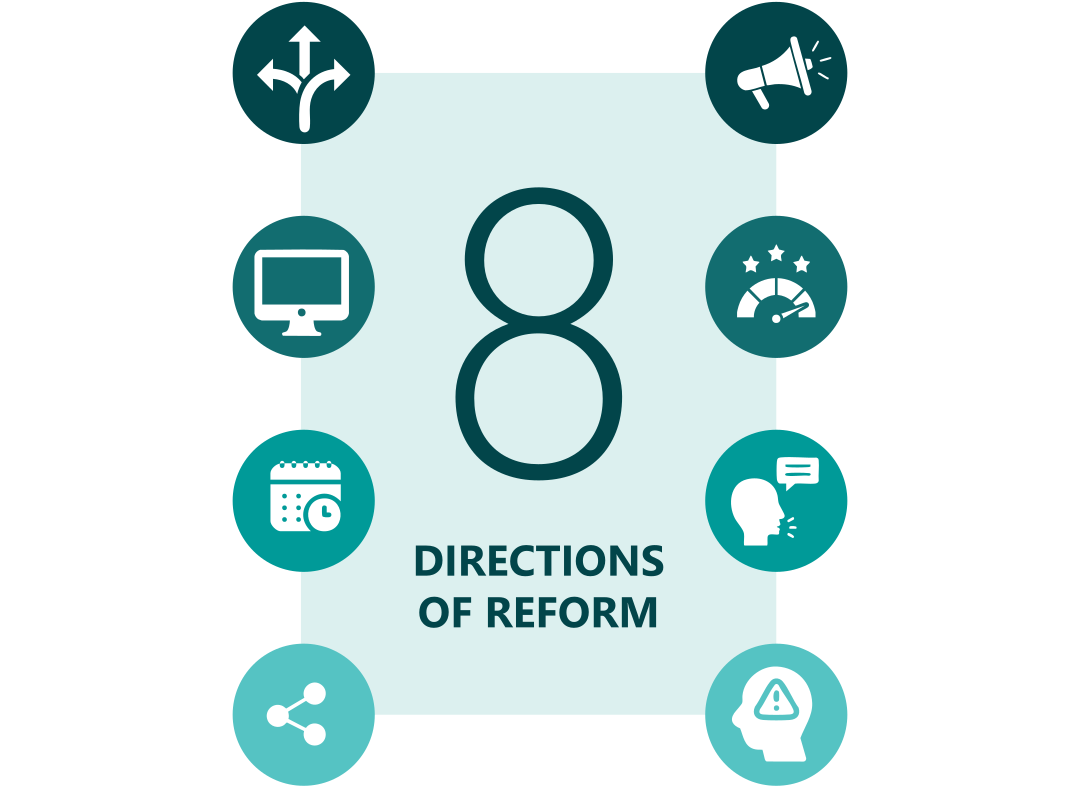
A strategy can help to better manage resources, establish priorities, clarify roles and responsibilities of various stakeholders, and help to build capacity in specific areas. While strategies are not a cure-all, when used flexibly they are beneficial tools. Having broad objectives helps to harmonise communications activities across government and also provides a framework for measuring outcomes.
If the current mandate/regulatory framework for communications does not facilitate adaptation to address digital media approaches, then an adjustment of the legal framework could be helpful in order to allocate resources and better anchor new practices in institutional terms. There are different ways of addressing this challenge:
- Develop a separate digital communication strategies in order to focus capacity-building efforts on this crucial area.
- Have a social media policy to clarify roles and behaviour across government departments with respect to social media.
- Foster digital communication capacity by establishing communities of practice - an affordable and effective way to share expertise.
Develop regular communications plans that set out priority outputs with timetables and allocation of responsibilities, generally on an annual basis. A clear distinction exists, therefore, between longer-term and outcome-oriented communications strategies and more practical output-focused communications plans - they are complementary exercises. The communication plan can be informed by and be aligned with other government planning documents, such as annual government work plan, to maximise its effectiveness and impact.
Organise regular, weekly or daily co-ordination that helps ensure that planned activities are well implemented. Reviewing the effectiveness of regular communications staff meetings could benefit all administrations. To improve the productivity, hold different types of co-ordination meetings, rather than simply a routine weekly meeting involving the same participants each time.
As a complement to staff meetings, shared planning tools can be very useful. Common workspaces help CoG and ministry staff track activities in order to avoid scheduling conflicts and align messaging.
Effective policy communication relies on forward planning and sufficient resource allocation, and as such is closely linked to the integration of strategic tools (strategies, plans, calendars, and so on). But it also requires a broader culture change and depends on both political support and capacity building/training.
Well-planned communication efforts can successfully support the rollout of new laws or policies, ensuring public understanding, trust, and engagement. But to be successful, they need to be carefully planned in advance, with close and ongoing interaction between policy teams and communicators and an investment in partnering with external communications and media partners.
In order to ensure that evaluation avoids the ‘annual report’ trap, which is a common problem, governments should prioritise actionable insight (how to improve) rather than ‘showing off the good stuff’ as is the case on most annual reports. Digital platforms now make it easier to assess communications outcomes cost-effectively. This data allows communications teams to reflect on what drove success—be it strong narratives, visuals, or co-ordination and adjust plans for future communications activities accordingly.
Communications units at the centre of government can play an important standard-setting role by promoting and harmonising evaluation methods across departments and providing guidance.
Treat information integrity as a whole-of-government strategic risk that requires central co-ordination rather than isolated action by line ministries, with the CoG playing a key role in ensuring policy coherence, strategic direction, and rapid crisis communication. Develop public policy responses to address information manipulation, strengthen information integrity, and uphold freedom of opinion and expression. Media literacy training beginning at a young age is now an essential component of an information integrity strategy.
Government communications teams play a vital role in helping politicians explain and promote government actions to the public. Heads of government and ministers are elected to deliver on their political priorities, and it is logical that communications teams support that work. However, it is equally important that this is done in a way that upholds the core values of the civil service—integrity and objectivity, in particular.
Establishing dedicated channels for political content helps safeguard the integrity of official messaging. Clear sign-off procedures are also useful in defining who is authorised to speak on behalf of the government and in distinguishing between policy communication and political messaging.